|

Andrew
Wyeth Prints
Biography
Gallery
Inspirations
The
Wyeth Family
Andrew
Wyeth Autobiography, Vol. 1
The
Helga Pictures
Museum
Collections
Prints & Books for Sale
|
Andrew
Wyeth Groundhog Day
In
many Andrew Wyeth prints, there exists a distinguishing
bleak atmosphere. He depicts simplistic and
rustic scenes that have a mournful, yet poetic,
quality to them. The dichotomy in Andrew Wyeth
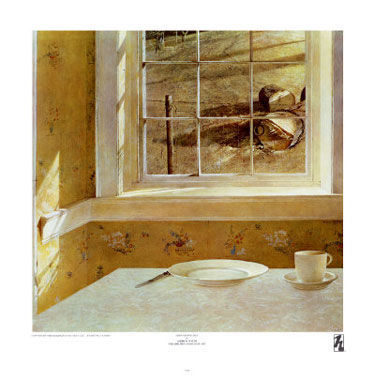
Groundhog Day prints is intriguing. Outside
the window is a gloomy scene. The grass is brown
and dead, and there lies a fallen tree with
jagged edges. The barbed wire fence and metal
chain add a harsh touch. This exterior scene
has strong connotations of death.
Andrew Wyeth was
said to be preoccupied with death, which gave his paintings a morbid essence
to them. The room depicted in the painting is, by contrast, surprisingly
orderly and colorful. The dishes are delicately placed; the white tablecloth
is fresh and crisp-looking. The space is unadorned, but very clean. The
wallpaper is flowery. The whole room appears to mock the scene beyond
the window sill. The window, which is a recurring motif in many Andrew
Wyeth prints, seems to act as a barrier between the inner order and the
outer chaos. However, although it separates the two, it also keeps them
connected, just as life and order cannot exist without death and chaos.
The Two Sides
of Andrew Wyeth
There is a delicacy and strength inherent in
every Andrew Wyeth print, a trait that is especially
noticeable in the Andrew Wyeth Groundhog Day
prints. The fragility of the white dishes is
starkly contrasted with the presence of the
barbed wire fence and metal chain pictured outside.
One aspect conjures the idea of resiliency in
the viewer’s mind, while the other represents
the threat of breakage. Moreover, the vegetation
outside the window will die and be reborn with
the changing of the seasons, as the flowers
on the wallpaper shall stay in bloom forever
and ever. We can assume that Wyeth delights
in presenting dichotomies in his works, contrasting
weakness and strength, the gentle with the harsh,
and order with disorder.
The Title
It is interesting to speculate on the reason why Wyeth decided to title
his work “Groundhog Day”. On this holiday, the coming of spring
rests on the condition that the groundhog does not see its shadow when
it comes out of its burrow. If the day is cloudy and does not cast shadows,
the animal judges this to be a sign of spring and will stay above ground.
Conversely, if the groundhog comes out and it is sunny, it sees its shadow
and takes this as a sign that it is not yet spring and retires back to
its burrow for six more weeks. In Andrew Wyeth Groundhog Day prints, it
is obviously a sunny day because of the shadows present. This leads viewers
to believe that the groundhog will assume six more weeks of dreary, wintry
weather. It lends a sense of foreboding to the print. This painting represents
another of Wyeth’s famous juxtapositions. The audience is privy
to the information that winter is not over, yet the title connotes feelings
of hope.
Groundhog Day is
known as the holiday of seasonal transition. It offers people, who are
weary of winter, a certain hope that warm spring weather will appear before
the scheduled calendar date of March 21st. Andrew Wyeth Groundhog Day
prints hold that comparison of hope and disappointment. Once again, Andrew
Wyeth managed to take simple, everyday objects and concepts and infuse
them with a visceral and haunting quality.
Andrew
Wyeth Prints - Inspirations
- Biography
- The Wyeth Family
The Helga Pictures
- Museum Collections
- Links - Site Map
|